

The Reference table is a newly-introduced table, which describes how to subtract noises from atmosphere and instruments. When we observe any target, a receiver outputs a summation of power throughout the path from the line-of-sight: the emission of the target and noises from the atmosphere and instruments including the radio telescope itself. In order to derive the emission of the target, there are two ways to subtraction of the noise. One is a position-switch method, the other is a frequency-switch method. For this observing season, a frequency-switch method is NOT implemented on the nobs.
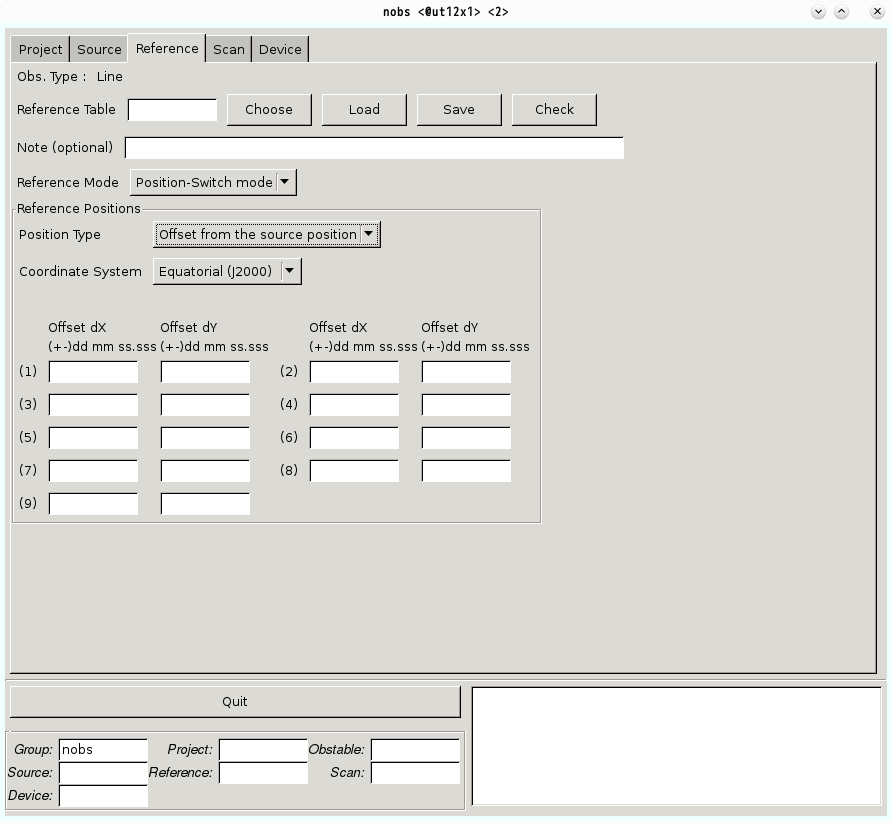
Reference Table [mandatory field]
This field defines a name for the reference table. The file will be saved in your working directory, which is the same as ‘Project’ you entered at the Project tab. For example, your account ID, project name, and a name of the reference table are ‘newobs’, ‘proj1’, and ‘ref1’, respectively, your file is saved in
/home/newobs/proj1/obstable/
with a name of ‘ref1.nreference’.
As other tables, a filename should follow the rules described below:
- The filename has 16 character limit.
- The filename does not contain any capital character.
- The first letter of the filename should be one of the alphabetical letters.
- The subsequent letters should be composed of alphanumeric, hyphen-minus sign, or underscore sign.
NOTE: You can save the input parameters anytime you want (the nobs allows you to save the reference table even if some mandatory fields still blank). The nobs does not check whether these input parameters follow the rules at that time.
Note (optional)
You can use this space to write any note about the reference table. A character limit is 100, and a line break is prohibited.
Reference Mode [fixed field]
It is needed to observe blank-sky (i.e., an emission-free region of the sky) that is close to the target, whose condition can be regarded as the same as the atmosphere at the target, and subtract the blank-sky data from the target data. This position of the ‘blank-sky’ is called as an ‘off-position’. Current nobs implement only ‘position-switch’ mode.
Position-Switch mode
- Position Type [mandatory field]
Choose a method to specify the off-positions from ‘Absolute position’ and ‘Offset from the source position’.- ‘Absolute position’
With this type, you can directly specify the off-position in the coordinate system, which you choose at ‘Coordinate System’. This position type would be effective when no bright source at the frequency you intend to observe are expected around the target (For example, along with the Galactic plane). - ‘Offset from the source position’
The off-position will be defined as a position from the target which is defined in the source table. This position type is useful especially for extragalactic sources, around which no emission and absorption is expected.
- ‘Absolute position’
- Coordinate System [mandatory field]
Choose the coordinate system from ‘Equatorial (J2000)’, ‘Equatorial (B1950)’, ‘Galactic’, and ‘Horizontal’. 9 off-positions can be stored at maximum.
NOTICE:
1. You must choose the same coordinate system specified in the source table.
2. In case of using ‘On-On’ or ‘Cross Point’ in the scan table, the nobs automatically adopts the off-position written in (1) fields.- Right Ascension, Declination
When you choose ‘Equatorial (J2000)’ or ‘Equatorial (B1950)’, off-positions are described in (α, δ) coordinate system. - Gal. Longitude, Gal. Latitude
If ‘Galactic’ is chosen in ‘Coordinate System’, off-positions are regarded as written in (l, b) coordinate system. - Azimuth, Elevation
Specification off-positions in (Az, El) coordinate system is available when ‘Horizontal’ is selected in ‘Coordinate System’. - Offset dX, Offset dY
If you choose ‘Offset from the source position’ in ‘Position Type’ field, an off-positions should be written as offset from the source position, which you define in the source table.
- Right Ascension, Declination
Recommended Setup for a Pointing Observation
For a pointing observation with a SiO maser (both for 43 GHz and 86 GHz), we recommend to use the following parameters:
- Reference Mode: Position-Switch mode
- Position Type: Offset from the source position
- Coordinate System: Horizontal
- Offset dx: 0 3 0 (meaning 0 deg 3 arcmin 0 arcsec)
- Offset dy: 0 0 0
If you observe H2O maser at 22 GHz for checking pointing accuracy, the same parameters are recommended except for ‘Offset dx’ of ‘0 3 0’ but ‘0 6 0’.