


概要
A Vietnamese research team, led by Dr. Quang Nguyen Luong (Director of the Institute of Space Quantum Communication and Astronomy, IAS) and Prof. Dinh Van Trung (Director of Institute of Physics, Vietnam Academy of Science and Technology), along with an international research team led by Dr. Fumitaka Nakamura (National Astronomical Observatory of Japan, NAOJ), have conducted a wideband radio spectral survey of CIT 6, the second strongest radio-emitting carbon star (note 1) in the sky. Through this survey, the team gained new insights into the chemical processes within the gas layers surrounding the star. This study has yielded new insights into the chemical processes within the gas layers surrounding the star. This research marks one of the first scientific achievements using the newly installed “eQ (extended Q-band) receiver,” a new instrument jointly developed by Japan and Taiwan and recently installed on the Nobeyama 45-m Radio Telescope.
“Chemical Factories” Surrounding Dying Stars
Stars like the Sun evolve into “Asymptotic Giant Branch (AGB) stars (note 2)” at the end of their lives, playing the role of a “chemical factory” that synthesizes complex molecules in their surroundings. Until now, detailed investigations of the chemical composition of carbon stars were largely limited to a specific object: IRC+10216 (CW Leonis), the brightest carbon star in the millimeter and infrared sky. Whether its chemical evolution process was common to other carbon stars was only partially understood and remained far from clear. However, in this study, the team used the high-sensitivity eQ receiver to perform the first unbiased molecular detection in the 30-50 GHz (wavelength: 6-10 mm) range for CIT 6 (RW Leonis Minoris), the second brightest star of its kind, and compared molecular abundances. The results demonstrated more definitively that different carbon stars undergo similar chemical evolution. By expanding such observations, we expect to reveal a universal picture of the material supply that serves as the building blocks for next-generation stars and planets.
CIT 6 (also known as RW LMi), the subject of this observation, is known as the second-brightest carbon star in the sky. However, compared to the most famous carbon star, IRC+10216 (CW Leonis), its detailed chemical composition had not been extensively investigated until now.
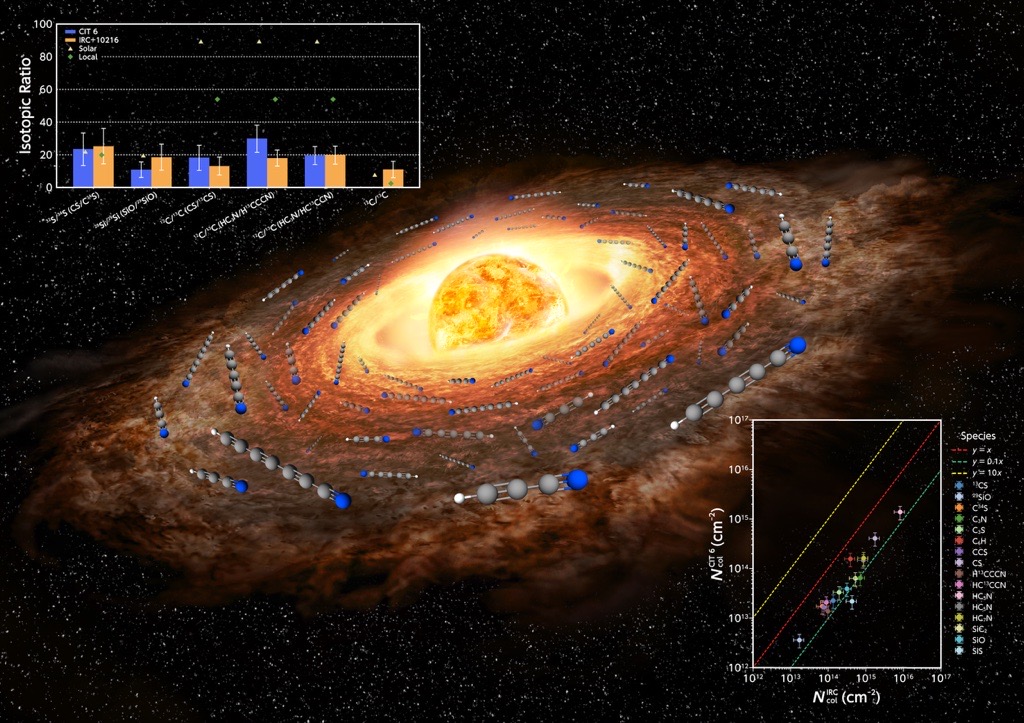
Figure 1. Artist’s image of CIT 6, which illustrates the formation of complex molecules in gas ejected from the star.
The True Face of CIT 6 Captured by the New eQ Receiver
The research team performed high-sensitivity observations of CIT 6 using the new 30–50 GHz band receiver, “eQ,” on the Nobeyama 45-metre radio telescope. This state-of-the-art receiver is capable of observing a wide frequency range simultaneously, allowing for the efficient detection of signals from numerous molecular species. The observations detected emission lines from a diverse range of molecules around CIT 6, clarifying molecular abundances, isotopic ratios, and temperatures. The key findings in comparison with IRC+10216 are as follows:
- Changes in Chemical Composition with Physical Evolution: The molecular abundance of CIT 6 is approximately one-tenth that of IRC+10216, indicating that CIT 6 is in a more advanced evolutionary stage. As evolution progresses, the ejected gas expands further, decreasing in density. This allows ultraviolet radiation from the star to reach and break down molecules over a wider area without being shielded, resulting in lower molecular abundances.
- Depletion of Silicon- and Sulfur-bearing Molecules: A significant decrease was found in molecules containing silicon and sulfur, such as SiS and CS. This suggests that these molecules may have been incorporated into dust grains or destroyed by shocks in the star’s vicinity.
- Persistence of Carbon-Chain Molecules (note 3): On the other hand, long carbon-chain molecules like HC5N and HC7N remain relatively abundant, confirming that carbon-chain chemistry operates efficiently even in evolved environments.
- Extraction of Internal Stellar Information: The carbon isotope ratio (12C/13C) was found to be low, and the silicon isotope ratio (28Si/29Si) was also slightly lower than that of the solar system. These ratios reflect the characteristics of the nuclear fusion processes occurring deep within the star and provide clues to the history of the star’s evolution. For example, among elements produced by nuclear fusion, the proportion of 13C is high; the observation of this in CIT 6 confirms a significant presence of gas dredged up from the interior, which is a hallmark of carbon star evolution. The silicon isotope ratio may reflect the star’s birthplace (location within the Galaxy) or the history of galactic chemical evolution driven by previous generations of stars.
Through these observations, the fact that two carbon stars at different evolutionary stages exhibit similar molecular abundance ratios confirms that there is a commonality in the molecular formation processes of carbon stars, and that ultraviolet radiation from the central star plays a decisive role in these processes. Moving forward, we aim to maximize the high sensitivity and wideband capabilities of the eQ receiver to investigate a larger number of carbon stars at various evolutionary stages. This will help determine whether these chemical characteristics are universal or influenced by other factors-such as ultraviolet radiation from the stellar body or the structure of circumstellar gas-thereby elucidating the process of element supply to the universe through carbon stars.
Future Outlook
These results demonstrate that the eQ receiver is a powerful tool for comprehensively investigating the chemical composition of circumstellar envelopes. Furthermore, this research represents a significant milestone in the deepening scientific partnership between the National Astronomical Observatory of Japan and the newly established Institute for Astronomy and Space Quantum Communications (IAS) in Vietnam.
Moving forward, the research teams from both countries plan to advance further joint research to unravel interstellar chemistry and cosmic structures through projects such as the Broadband Low-frequency Astronomical Detection Experiment (BLADE) planned in Vietnam.
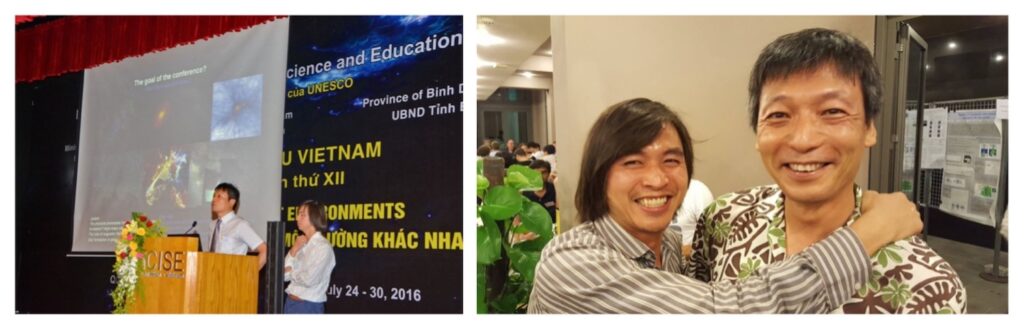
Figure 2. (Left) Reserchers on this press release are presenting their study at an international conference held on the International Centre for Interdisciplinary Science and Education (ICISE) in Quy Nhon, Vietnam. (Right) Fumitaka Nakamura (right) and Quang Nguyen Luong (left).
Paper Information
Title: “A spectral-line survey of CIT 6 between 30 and 50 GHz with the eQ receiver at NRO 45 m”
Authors: Quang Nguyen-Luong (IAS Vietnam), Fumitaka Nakamura (NAOJ), Kotomi Taniguchi (NAOJ), and others
Journal: Astronomy & Astrophysics, Volume 706, Article A127 (2026)
DOI: https://doi.org/10.1051/0004-6361/202558033
Footnote
Note 1: Carbon Stars
Carbon stars are evolved stars, primarily in the Asymptotic Giant Branch (AGB) stage, where carbon produced by internal nuclear fusion is transported to the surface via convection, resulting in a carbon abundance that exceeds oxygen (C/O > 1). Accompanied by intense mass loss, the expelled gas forms a disk-like circumstellar structure, eventually evolving into a planetary nebula. Because carbon molecules and dust efficiently absorb blue light, these stars appear strikingly red, playing a crucial role in the chemical evolution of the universe by supplying carbon and heavy elements to interstellar space.
Note 2: Asymptotic Giant Branch (AGB) Stars
AGB stars represent a late evolutionary stage of Sun-like stars that have expanded significantly toward the end of their lives, vigorously ejecting synthesized elements like carbon into space. Many variable stars with significant luminosity fluctuations belong to the AGB class. Since the materials they release become the building blocks for next-generation stars, planets, and potentially life itself, they serve as essential “element recycling factories” in the universe.
Note 3: Carbon-Chain Molecules
Carbon-chain molecules are structures consisting of carbon atoms linked in a chain-like fashion. They are found abundantly in the cold molecular clouds of interstellar space and in the envelopes surrounding carbon stars. Represented in radio observations by species such as HCnN (cyanopolyynes, where n is an integer), they are considered crucial intermediates in the chemical evolution toward more complex organic molecules.